CAFÉ HACKING HEALTH MONTRÉAL: OBJECTS CONNECTED IN HEALTH / THE INTERNET OF THINGS
Info
ENGLISH WILL FOLLOW
Visionaries share their advances in the field of connected health!
Come meet Pierre-Alexandre Fournier, co-founder and CEO of Hexoskin, Nicolas Tremblay, Founder of NeuroServo Inc., and Ferdinand Ephrem, founder and director of Saintrino Technologies Inc.
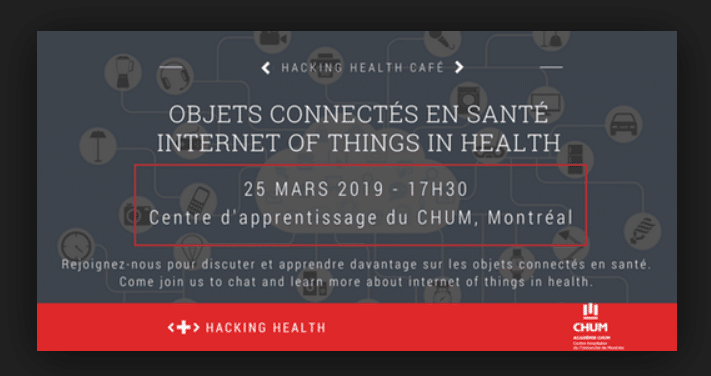
In the digital age, connected objects (IoT) are increasingly present in the health sector and are revolutionizing the practices of this field. Hacking Health Montréal invites you to take part in its café on March 25, 2019 at 5:30 p.m. at the CHUM learning centre to learn more about certain health innovations related to connected objects.
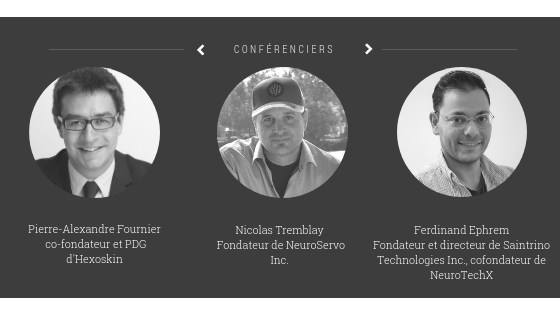
- Pierre-Alexandre Fournier, co-founder and CEO of Hexoskin, a Montréal-based connected-health company specializing in wearable health sensors and analysis software for health and performance. Hexoskin was founded in 2006 and in 2013 launched the world’s first iPhone-compatible biometric garment. The company has won several international awards for its connected-health and « wearable » products. Since 2018, Hexoskin’s remote vital-signs monitoring technology has been operational on the International Space Station. Pierre-Alexandre is also involved in promoting data transparency in medicine, as well as design and innovation in health.
- Nicolas Tremblay, Founder of NeuroServo Inc. Nicolas is an electrical engineer specializing in high-precision robotics (nanometre displacements), with 20 years of experience designing robotic, electronic and software systems. In 2015, drawing on his past expertise and the principles of precision in robotics, Nicolas founded NeuroServo Inc. and managed to create NeuroServo’s first product, which already enjoys an excellent reputation: a Bluetooth EEG system concealed in a high-end cap, specialized for detecting and working on attention. Today, NeuroServo is completing the development of a new portable electroencephalogram (EEG) tool to detect delirium in hospitals at an early stage. This new project, « I Seek Delirium, » which enters the clinical-trial stage in April 2019, also earned him (with his team) the « health » prize at Coopérathon 2018.
- Ferdinand Ephrem, founder and director of Saintrino Technologies Inc. and co-founder of NeuroTechX. As founder and director of Saintrino Technologies Inc. and co-founder of NeuroTechX, Ferdinand brings broad experience in the fields of brain-computer interaction (BCI), management information systems, consulting, project management and user experience. Saintrino Technologies has developed expertise in neurotechnology, in particular by integrating data from different sources, such as EEG and eye tracking, used in research or industrial projects. Working in cooperation with many academic and non-profit organizations, his team gives academic innovations a chance to be implemented in real-world applications.
The evening will conclude with a networking session accompanied by snacks and refreshments.
In the digital age, the internet of things is gaining interest in the health sector. Hacking Health Montreal invites you to its café on March 25th, 2019 at 5:30 pm. The café will be held in CHUM’s learning center. Come find out about new innovations that link healthcare to the internet of things.
Three entrepreneurs will tell us about latest work:
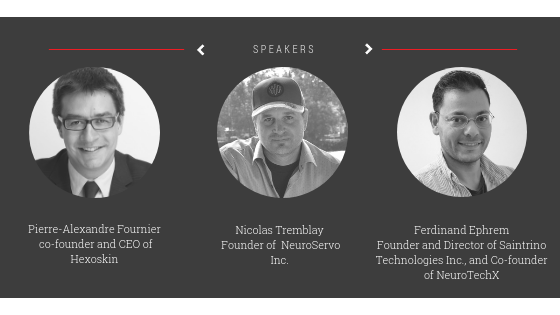
- Pierre-Alexandre Fournier is co-founder and CEO of Hexoskin, a Montréal-based company focused on clinical-grade wearable sensors and AI software for health and clinical research. Hexoskin was founded in 2006 and launched in 2013 the first iPhone compatible smart clothing for health monitoring, which won several international awards. In 2018 Hexoskin launched a remote health monitoring system for astronauts to the International Space Station. Pierre-Alexandre is also an advocate for transparency in healthcare, patient empowerment, and healthcare innovation through design.
- Nicolas Tremblay, Founder of NeuroServo Inc.. Nicolas is an electrical engineer specialized in high-precision robotics (nanometer displacements), he has 20 years of experience in design of robotic systems, electronic, software and firmware. In 2015, Nicolas founded NeuroServo Inc., building on his past expertise and the acquired concepts of precision in robotics, Nicolas managed to create the first NeuroServo product that already has an excellent reputation, namely a Bluetooth EEG system hidden in a specialized high-end cap for detection and work on attention. Today, NeuroServo is completing the development of a new portable electroencephalogram (EEG) tool to detect delirium in hospital settings at an early stage. This new project, which goes into clinical trials in April 2019, has also won the « health » prize of Cooperathon 2018.
- Ferdinand Ephrem, Founder and Director of Saintrino Technologies Inc., and Co-founder of NeuroTechX. As Founder and Director of Saintrino Technologies Inc., and co-founder of NeuroTechX Ferdinand brings a wealth of experience in Brain Computer Interaction (BCI), Management Information Systems, Consulting, Project Management and User Experience. Saintrino Technologies has developed expertise in neurotechnology, in particular integrating data from different sources, such as EEG and eye tracking used within research or industrial projects. Working in cooperation with many academic, and non-profit organizations, his team provides academic innovations a chance to become implemented in real world applications.
The evening will end with a networking session accompanied by snacks and refreshments.
Presentations will be in French but Questions and discussions are bilingual.
About the CHUM Direction of Education and Academy (DEAC)
The DEAC of the CHUM makes the integration of 4 main dimensions its mission, namely: Teaching, Learning, Communicating and Innovating.
Through its partnerships and involvement, the management aims to accelerate the creation and transfer of skills in order to improve patient care and health.
In short, this lies in a mandate to acquire, mobilize and share knowledge.
The DEAC also plays a leading role within theSchool of Artificial Intelligence in Health.
******************
About the Education and Academy Direction of the CHUM:
The CHUM’s Direction of Education and Academy has integrated 4 main dimensions in its mission: Teach, Learn, Communicate and Innovate.
Through its partnerships and involvement, the management wants to accelerate the skills creation and transfer in order to improve patient care and health. It can be summarized in a mandate that aims to acquire, mobilize and share knowledge.
DEAC also has a leading role in the School of Artificial Intelligence in Health.