


Digital Citizenship: Quebec Researchers Join Forces to Prevent Cyberbullying Among Young People


As part of the 93rd Acfas Congress held at the Université du Québec à Trois-Rivières, the interdisciplinary symposium “The Challenges of Cyberbullying Among Young People: Societal Issues Related to Cyberviolence” brought together researchers, experts, and practitioners.
Organized by Printemps numérique, this conference highlighted concrete initiatives. Among them was the launch of a reference tool: the Competency Framework for Preventing Cyberbullying Among Youth, designed to guide educational and community settings in responding to the rapid changes in virtual spaces.
A Solid theoretical framework for complex practical skills
To address the increasing use of digital technology among adolescents, Printemps numérique, in collaboration with the Ministry of Family Affairs, launched a knowledge mobilization initiative. Led by researcher Amina Yagoubi (TÉLUQ), this collaborative co-creation process brought together experts from the educational, academic, community, and private sectors.
It led to the development of the Competency Framework for Preventing Cyberbullying Among Youth (Yagoubi, 2025), structured according to the DACUM method and drawing on the taxonomies of Bloom (1956) and Krathwohl et al. (1969). This 108-page guide approaches competencies as “complex practical knowledge” (Tardif, 2006). It is organized around five themes of digital citizenship (social, personal, legal and security, technical, and non-technical aspects) divided into two approaches (reflective and pragmatic), four dimensions (society, individual, education, justice), four types of knowledge, and eleven major categories. The tool provides a logical framework for designing training programs tailored to real-world contexts.
“Our goal is to build a healthier, more inclusive, and safer digital environment for all young people in Quebec,” explains Mehdi Benboubakeur, executive director of Printemps numérique. “This framework provides a common language and clear guidelines to harmonize and strengthen the consistency of educational initiatives across all areas of life.”
Measuring bullying using real data from the EVIO platform
Effective prevention is based on evidence. Researchers Laura Iseut Lafrance St-Martin (UQAC), Stéphane Villeneuve (UQAM), and professional Louis-Raphaël Tremblay (Optania) propose a novel approach based on data from Optania’s EVIO digital platform. Unlike traditional studies based on self-reported data, this collaborative project analyzes anonymized institutional reports.
Using a mixed-methods approach that combines quantitative statistical analyses (time, location, frequency) with qualitative thematic analyses of descriptions provided by school staff, the tool makes it possible to identify concrete trends. Preliminary results show a marked improvement in incident tracking at participating school service centers, thereby strengthening the response capacity of school teams.
In addition, Stéphane Villeneuve and Laura Iseut Lafrance St-Martin conducted an exploratory analysis cross-referencing these reports with publicly available socioeconomic indicators. This approach allows for a scientific analysis of the dynamics of school violence by educational level (elementary and secondary) and explores differences in prevalence between schools in order to equitably adjust the allocation of support resources.
The hybrid nature of violence and the parental blind spot
The line between physical and cyberbullying is becoming increasingly blurred. An in-depth qualitative analysis conducted by Dario Francesco Bonomo, Alexandre Kotowicz, and Valentin Noblet-D’Agostino (UQAC) on 20 complex cases of cyberbullying—extracted using a custom Python script from a database of 9,922 school-related incidents—shows that more than half of the situations are hybrid.
Bullying occurs simultaneously in physical hallways and on platforms such as Snapchat. This hybrid reality requires us to move beyond the traditional dichotomy between physical and digital spaces when taking action. The study also highlights a significant gap in perception: while students report both general bullying and sexual violence, parents report almost exclusively the latter, revealing a clear lack of awareness of other forms of cyberviolence.
Clinical and play-based approaches: art therapy and toxicity analysis
To support affected youth—more than 50% of whom report psychological distress and lowered self-esteem, particularly among vulnerable populations (LGBTQIA+, First Nations, students with special needs)—Florence Brisson-Dyens (UQAT) is exploring the potential of art therapy in a clinical setting. This sensitive and intersectional approach offers a space for nonverbal expression that fosters resilience and a positive re-appropriation of self-image.
At the same time, the struggle is spreading to the entertainment industry. Laura Iseut Lafrance St-Martin (UQAC) and Maude Bonenfant (UQAM) presented the findings of more than a decade of research on toxicity in video games, which will be published as a monograph in September 2026. Exposure to toxic behavior is documented in the study through statistics. These data confirm that toxicity is not a marginal behavior, but a culturally entrenched phenomenon, prompting studios to allocate resources to modify the design of their platforms.
From the lab to the classroom: design research in action
Finally, to ensure that this scientific knowledge is applied in the field, Jérémie Bisaillon (UQAM), Annie Turbide (RECIT), and Stéphane Villeneuve (UQAM) launched a design-based research project in education. Working closely with teachers, they developed learning activities for elementary school students, tailored to the requirements of the new Quebec Culture and Citizenship (CCQ) curriculum. This initiative resulted in the creation of an interactive self-paced training program, supporting teachers’ ongoing professional development in addressing the challenges of cyberviolence.
Similar posts
Digital Education
read the article
Recap of the 19th EURÊKA! Festival: Digital Spring Propels 'The Scientific Momentum'
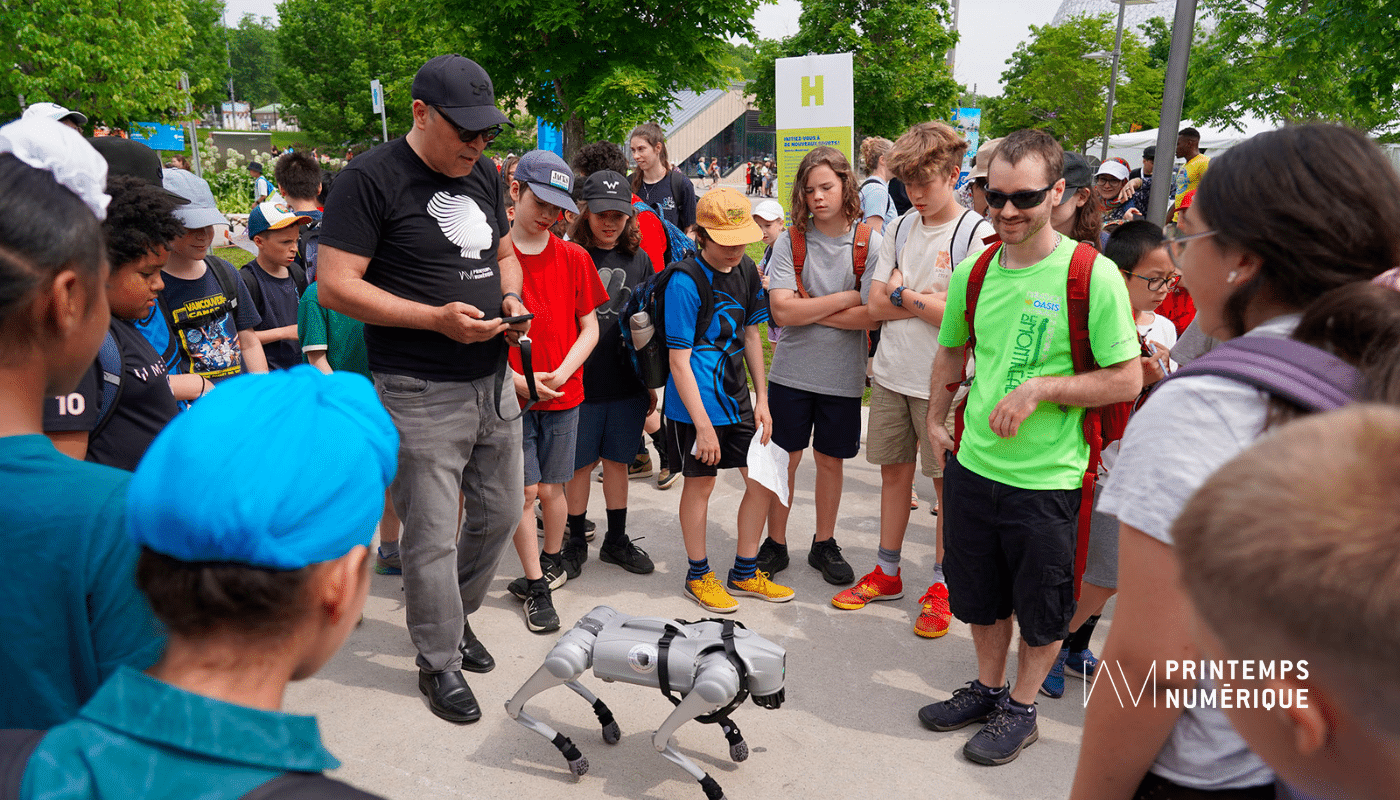
Last June 5, 6, and 7, the Digital Spring team had the pleasure of hosting a Digital Café during the 19th edition of the EURÊKA! Festival, which took place at Parc Jean-Drapeau under the theme of 'The Scientific Momentum.' This event was an opportunity to invite the public to discover how science and technology, such as artificial intelligence, are concretely transforming the world of sports.
Artificial Intelligence
read the article
Empowering Educators to Teach AI: A Look Back at Printemps numérique's Participation in AQUOPS 2026
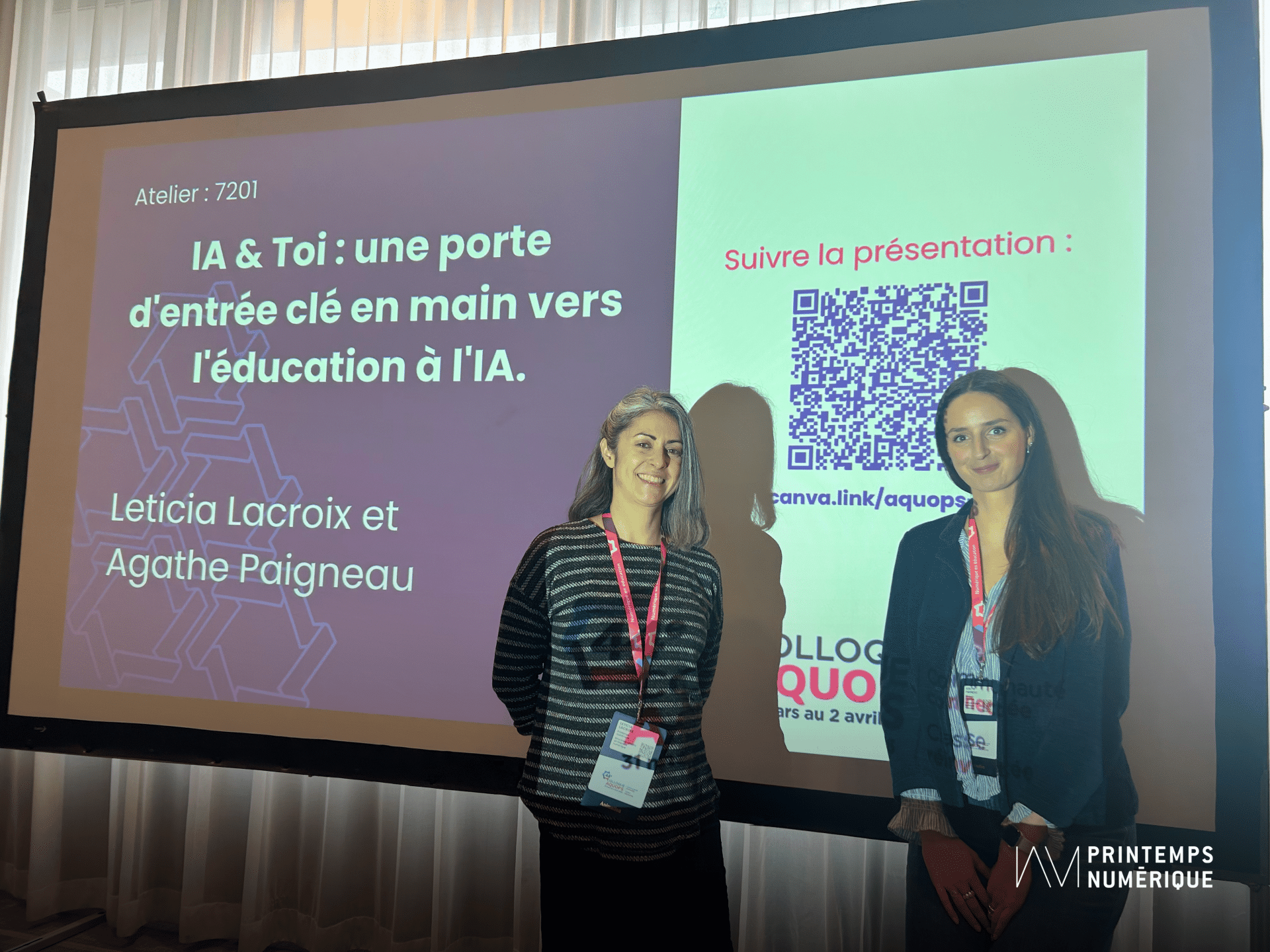
Printemps numérique participated in the 44th AQUOPS Conference, held in Québec City from March 31 to April 2, 2026, where it presented the workshop "AI & You: A Ready-to-Use Gateway to AI Education." The goal was to introduce Quebec's education community to an accessible, practical, and responsible approach to teaching and learning about artificial intelligence.